Georgia Pre-K: Meets all 10 Quality Benchmarks for National Assessment
Print This PostResearch Summary 18
Fall 2026
In April 2026, the Georgia Pre-K program became the first universal state Pre-K program in the country to meet all 10 quality benchmarks set out by the National Institute for Early Education Research (NIEER). In this research summary we describe those 10 quality benchmarks and how Georgia was able to meet each of them. There are over 70,000 children served by Georgia Pre-K, approximately 60% of all eligible 4-year-olds in the state. This summary includes an overview of the importance of child and family development as well as community engagement and makes recommendations regarding support for Pre-K.
The lottery funded Georgia Pre-K program serves over 70,000 four-year olds around the state (GEEARS, 2026). It provides educational opportunities for four-year-olds throughout the state to prepare children for elementary school (DECAL, 2026). It began in 1994 when Georgia became the first state to offer universal, tuition-free Pre-K to all 4-year-olds. When Georgia Pre-K began, they served 8% of four-year-olds and planned for universal coverage by 1995 (US Chamber, 2026).
National Institute for Early Education Research (NIEER)
The National Institute for Early Education Research (NIEER) conducts an annual assessment of the state of preschool opportunities in states. In their annual review of all states, they examine accessibility (ages served), resource rankings (spending), and 10 quality benchmarks (NIEER, 2026). In the 2025 NIEER State of Preschool Yearbook, Georgia became the largest state-funded preschool program in the country to meet all 10 quality benchmarks. This is an improvement from previous years when it met 8 of the 10 quality benchmarks (US Chamber, 2026). Georgia is the first universal (open to all children) preschool program to do so. There were 5 additional states that met all 10 of the benchmarks of quality (AL, HI, MI, MS, and RI) but none of the programs are as large as Georgia’s and they do not provide universal coverage (GEEARS, 2026).
Some of the key findings from the NIEER assessment in the 2024-2025 year.
- Georgia Pre-K currently serves 53% of 4-year-olds, 3% are in Head Start, 3% in Special Education, and 41% are in other early education settings.
- Georgia Pre-K is offered in all 159 counties. It operates 6.5 hours a day, 5 days a week throughout the school or academic year.
- State spending increased by 15% from the previous year. Funding was designated for program quality and accessibility.
- State spending per child increased from $6,400 in 2023-2024 to $7,630 in 2024-2025.
- The spending increase included $46 million for lead and assistant teacher salaries to bring salaries comparable to those of K-12 teachers (about a 13% increase for lead teachers; 77% of teachers receiving a raise). Assistant teacher salaries rose by 27.5%.
- Salary schedule includes recognition of years of experience and advanced credentials (specialist and doctorate).
The two graphs below from NIEERS show the funding for Pre-K, Headstart (HDST), and K-12 in terms of state, local, and federal contributions. The graph from 2023-2024 and from 2024-2025 are both shown below for comparison purposes.
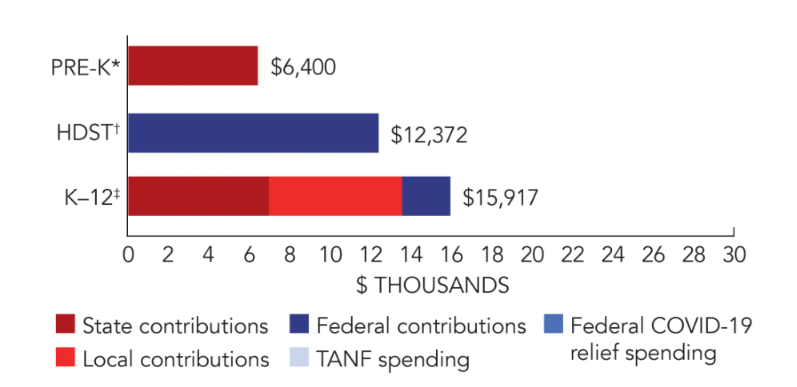
NIEERS – Georgia Profile 2023-2024
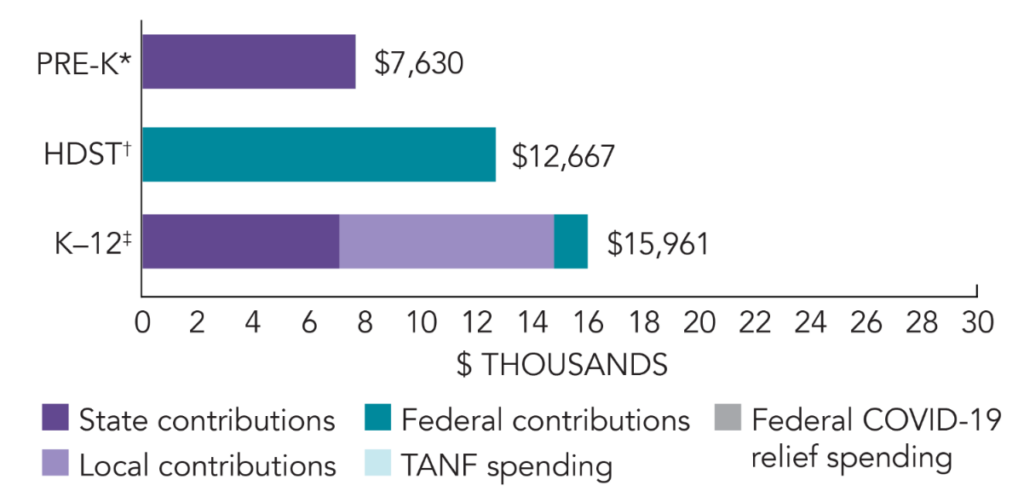
NIEERS – Georgia Profile 2024-2025
The funding increase is to be included in the state budget for the Pre-K program moving forward including funding for an additional 100 classrooms will be allocated each year. In addition, the 2024 funding increase included:
- $9 million to lower the maximum class size to 20 students and fund 100 new classrooms.
- $4 million to support increased transportation to all students.
- $11.5 million support to operating funds for private providers.
- $3.2 million to local school systems.
- $2 million for new classrooms.
- $11.5 million for classroom replenishment grants.
- $9 million for summer transition programs.
- $1.4 million for staffing positions in the Department of Early Care and Learning (DECAL).
- State allocations for Pre-K are now equivalent to state investment in K-12 (K-12 has additional federal and local contributions).
NIEER Benchmarks
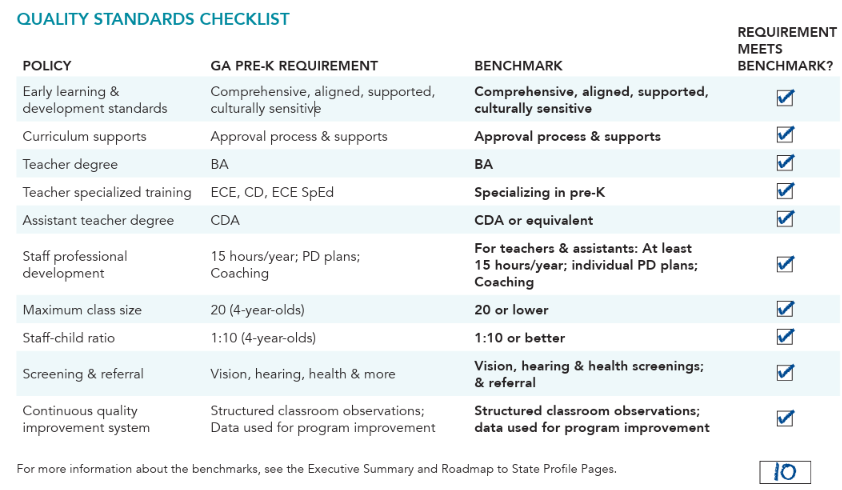
Early Learning & Development Standards: This benchmark focuses on ensuring comprehensive early learning and development standards that guide teaching and assessment. They should include physical well-being, gross and fine motor development, social/emotional development, and culturally sensitive approaches.
Curriculum Supports Benchmark: This benchmark addresses the approval process and supports utilizing an evidence-based curricula aligned with early learning standards and ensuring there is guidance and approval for selection of curriculum. In addition, it evaluates training or technical support to staff to implement the curriculum.
Teacher Degree Benchmark: This benchmark addresses teacher education and preparedness and requires lead teachers to have at least a bachelor’s degree. One of the recent updates in Georgia, provides additional funding and salary support to teachers as well as requirements for a bachelor’s degree for all lead teachers.
Teacher Specialized Training Benchmark: Teachers are required to have specialized training in early education and Pre-K. In Georgia, teachers are required to have early childhood, child development, or special education degrees or credentials. This can include a Bachelors degree in an unrelated field with 15 or more hours of classwork in the early childhood education field.
Assistant Teacher Degree Benchmark: The benchmark is for all assistant teachers to have a Child Development Associates degree (CDA) or equivalent. Georgia’s requirement is that all assistant teachers must have a CDA.
Staff Professional Development Benchmark: Ensures teachers and assistants have at least 15 hours of continuing development education each year, individual professional development plans, and coaching for teachers to continue to improve teaching efficacy. Georgia met these criteria with 15 hours per year required, professional development plans, and coaching to improve efficacy.
Maximum Class Size Benchmark: This benchmark is to have no more than 20 students per classroom. Georgia increased funding for teachers and infrastructure to reduce classroom sizes to reach this benchmark. This was one of the two benchmarks that Georgia did not meet in 2023-2024 but did in 2025. The maximum class size in 2023-2024 was 22, funding increased to increase the number of classrooms helped to reach the new 20 students per classroom.
Staff to child Ratio Benchmark: The benchmark is 1 teacher for every 10 students. This ratio is met in Georgia in all Pre-K classrooms. In many classrooms, this is met by having one lead and one assistant teacher. This was one of the two benchmarks that Georgia did not meet in 2023-2024 but did in 2025. In 2023-2024, the ratio in Georgia was 1 teacher for each 11 students.
Screening & Referral Benchmark: There are vision, hearing, health, and developmental screenings of children with referrals made to needed services. This includes special learning development screenings. Georgia currently provides vision, hearing, health and more screenings for all children in Pre-K.
Continuous Quality Improvement System Benchmark: There is a system in place to assess program quality, and the data is used to guide improvement. DECAL provides a CQI system as well as releasing the data publicly to help inform program improvements and to allow communities to help support programs.
Key Lessons
NIEER, the US Chamber, and GEEARS point out that Georgia’s meeting of all 10 benchmarks demonstrates that it is possible to provide a universal state-funded preschool with the key quality components of:
- Well-qualified teachers,
- Pay parity with K-12,
- Small class sizes,
- Continuous quality improvement systems,
- Secure dedicated funding helps protect programs from annual budget fights,
- Phased rollout plan beginning with a pilot for those most at need and then scaling up, and
- Focus on maintaining quality includes areas like strong quality standards with support like scholarships for teacher education.
The NIEER report points out that Georgia’s continued focus on creating scalable solutions and continuing to increase investment in early childhood education has contributed to the continued improvement in quality of the universal Pre-K in the state.
Georgia’s improvement from 8 to 10 of the benchmarks was due to the financial investment and focused investment in teacher support and additional classroom space. These two key changes helped Georgia achieve its perfect score in the 2025 assessment by improving their performance on ratio and class size.
- Improving teacher to child ratio from 1:11 to 1:10.
- Lowering the maximum class sizes to 20.
Extensive outreach by state partners like GEEARS and Georgia Family Connection Collaboratives have led to reforms that have led to the star status. Organizations continue to advocate for Pre-K to be engaged with elected officials to increase awareness of the importance of continued funding and resources to maintain these improvements. In addition, organizations (like GEEARS and Georgia Family Connection Partnership) continue to provide education about the importance of early care and education related to literacy through school years and supports for quality improvement efforts (GEEARS, 2026). The additional funding that was designated for Pre-K in 2024 allowed for pay parity for Pre-K teachers and a return to class sizes of 20 students per class. It also provided increased transportation support, startup grants, summer transition programs and operation budgets. The budget was increased by almost $100 million in 2024.
Based on the findings, Georgia’s next steps should be to actively promote increasing enrollment, expanding the number of available classrooms, and continuing to support teacher professional development (GEEARS, 2026).
Check out the Georgia State Profile in the State of Preschool 2025 Yearbook from the National Institute for Early Education Research (2026).
Connect with us on Facebook.
Bright from the Start: Georgia Department of Early Care and Learning (DECAL) is responsible for meeting the child care and early education needs of Georgia’s children and their families. It administers the nationally recognized Georgia’s Pre-K Program, licenses child care centers and home-based child care, administers Georgia’s Childcare and Parent Services (CAPS) program, federal nutrition programs, and manages Quality Rated, Georgia’s community powered child care rating system.
The department also houses the Head Start State Collaboration Office, distributes federal funding to enhance the quality and availability of child care, and collaborates with Georgia child care resource and referral agencies and organizations throughout the state to enhance early care and education.